Birtwick Park
Black BeautyBirtwick Park is the estate where Black Beauty finds a first lasting home after leaving his earlier one, and where the book gives its clearest sustained picture of humane care as an everyday practice. Its grounds offer room to move and rest; its stable gives horses shelter and attentive company; and the conduct of Squire Gordon, his household, and their staff extends that care beyond the estate. Birtwick is therefore more than a comfortable setting: it is a measure against which the horse’s later experiences of neglect and exploitation can be understood.
Setting and Grounds
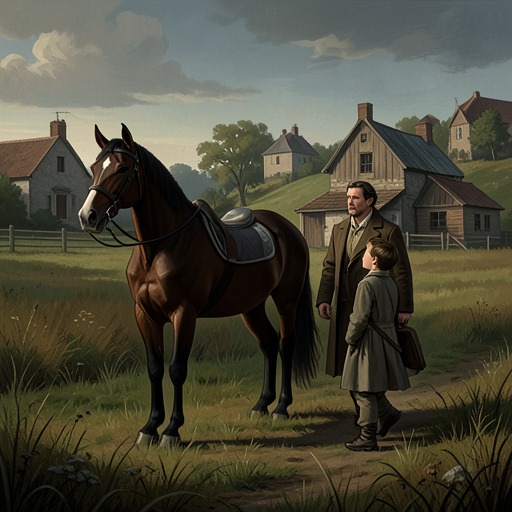
Squire Gordon’s park lay alongside the village of Birtwick. Visitors entered through a large iron gate beside a lodge, then followed a smooth road between clusters of old trees. A second lodge and gate led toward the house and gardens. Beyond them were the home paddock, the old orchard, and the stables. The estate could accommodate many horses and carriages, but Black Beauty’s account focuses on the stable that became his home.
That approach matters to the location’s character. The gates and lodges mark a passage from the village into a managed landscape, while the long, tree-lined road leads onward to the household and the animals’ working and resting places. The park is not presented chiefly through grand architecture or display; its defining spaces are those that make daily care possible: the paddock and orchard where horses can be turned out, and the stable where they are housed.
The Stable and Its Care
The stable was roomy, with four stalls and a large swinging window opening onto the yard. The window brought light and air into the building. One stall was a particularly large, enclosed space, fitted with a low hay rack and manger. Called a loose box, it allowed a horse to remain untied and move about freely. Black Beauty describes it as clean, comfortable, and airy, with iron rails at the top of its sides through which he could see what was happening around him.
The stable’s physical arrangements reflect a practical attentiveness to horses’ needs. The loose box offers more than shelter: it gives an animal space and a degree of freedom within the stable. Its position also allows the horse to remain connected to activity around him rather than shut away from it. In this setting, the stable becomes a place of social life as well as rest, shared by horses and by the people who care for them.
Daily Routines and Companionship
At Birtwick, exercise is treated as a response to a horse’s nature, not as a reason for punishment. John Manly understands that a spirited horse may become restless when kept from sufficient exercise. Rather than punish Black Beauty for that energy, he takes him out and gives him a brisk trot once they are beyond the village. John also communicates through his voice and the touch of the rein, and Black Beauty responds to him with trust.
On fine summer Sundays, the carriage does not go out because the church is nearby. The horses are sometimes turned into the home paddock or old orchard for a few hours. They can graze, gallop, lie down, and roll, and gather beneath a large chestnut tree. These periods of liberty give the animals room to choose how to spend their time; they also make space for conversation among them. The paddock and orchard thus belong to the estate’s working routine, but they briefly suspend work and allow companionship and play.
A Community Opposed to Cruelty
Birtwick’s humane character rests not only on its accommodation but on a shared standard of conduct. Black Beauty describes Squire Gordon and his wife as respected and kind to people and animals alike, and says that their servants follow the same example. Village children known to mistreat animals are corrected by people from the Hall. The household’s influence therefore reaches beyond the stable: care is presented as a public obligation, not simply a private preference.
Squire Gordon and Farmer Grey had worked together for more than twenty years to end the use of check-reins on cart horses in their area, where the practice had become uncommon. When Squire Gordon’s wife encountered a heavily laden horse forced to hold its head strained upward, she might stop the carriage, get out, and try to explain to the driver why the practice was cruel and foolish. This effort shows the park’s ethical outlook moving into the surrounding roads and community. It is not enough for the horses at Birtwick to be treated well if suffering elsewhere can be challenged.
Intervention and Narrative Significance
The same principle informs the stable community’s response to cruelty outside the estate. When Joe Green encounters a worker mistreating horses at a brick-yard, he reports what he has seen and agrees to give evidence if the matter is taken before a magistrate. John Manly praises his intervention, insisting that cruelty and oppression are everyone’s concern when they witness them. Joe returns to his stable duties proud of John’s approval, and is then summoned to provide his account. Birtwick is the home base from which this response is carried outward: the stable’s moral training leads to action beyond its gates.
A story James recounts also connects Birtwick’s present conduct to an earlier lesson against cruelty. As a schoolboy, he had confronted another boy who was tormenting flies; the schoolmaster punished the cruelty and taught the pupils that kindness to vulnerable creatures was a test of character. Recalled among the stable community, the episode reinforces the principle evident throughout life at the park: humane treatment requires both understanding and the willingness to intervene.
For Black Beauty, Birtwick is remembered as a place where good care is built into surroundings, routines, and relationships. Its paddock offers freedom, its stable provides comfort, and its people treat a horse’s behavior as something to understand rather than automatically suppress. By joining refuge with active opposition to mistreatment, the estate supplies the novel’s clearest example of what responsible human care can look like.